BMW 1438949 Engine High Pressure Fuel Injector Line Rail
fits model: E36, E39, E46, E53, E60, E85, M54. make: Bmw.
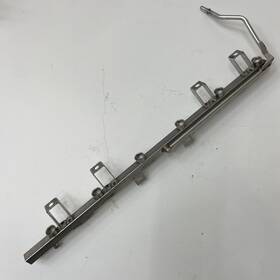
( Manufacturer Part Number: 1438949 ), ( Mounting Style: Bolt-on ), ( Type: Fuel Injector ), ( Connector Type: Male ), ( Universal Fitment: No ), ( Country Of Origin: Germany ), ( Fuel Type: Gasoline )
Review BMW Oem Engine High Pressure Fuel Injector Line Rail fits E36 E39 E46 E53 E60 E85 M54
The **BMW M54 high-pressure fuel injector line and rail assembly (part number 1438949)** represents a critical component of the legendary M54 inline-six engine, found in iconic models such as the E36 M3, E39 M5, E46 M3, E53 X5 M, and E60/E85 550i and 650i variants. This precision-engineered system is designed to deliver ultra-high-pressure fuel injection with exceptional accuracy, ensuring optimal combustion efficiency, power delivery, and emissions compliance across the engine s diverse applications. The rail assembly serves as the central hub for the high-pressure fuel pump, injectors, and pressure regulator, housing a robust steel or aluminum frame that withstands the intense forces generated by the M54 s direct-injection system, which operates at pressures exceeding 200 bar. Each injector in the line is meticulously calibrated to atomize fuel with pinpoint precision, minimizing waste and maximizing performance whether in the high-revving, naturally aspirated M3 or the turbocharged iterations of the M5 and X5 M. The rail s integrated design also incorporates a fuel return system and pressure sensors, allowing the engine control unit (ECU) to dynamically adjust fuel delivery in real time for seamless throttle response, improved cold-start reliability, and reduced emissions. Built to BMW s exacting standards, this component is engineered for durability, featuring corrosion-resistant coatings, high-tolerance machining, and seals that maintain integrity under extreme temperatures and pressures. Whether restoring a classic M3 or upgrading a modern 5 Series, this injector line and rail assembly ensures the M54 s legendary balance of power, refinement, and longevity, making it an indispensable part of any high-performance BMW application.
### **Pros and Cons of Buying a BMW with the M54 Engine (E36, E39, E46, E53, E60, E85) and High-Pressure Fuel Injector Line/Rail Issues**
The **BMW M54** is one of the most beloved inline-six engines ever produced, known for its reliability, power, and tunability. However, like all engines, it has its strengths and weaknesses particularly when it comes to **high-pressure fuel injector line and rail failures**, which became a common issue in later model years. Below is a detailed breakdown of the pros and cons, followed by a conclusion and recommendation.
---
### **Pros of the BMW M54 Engine**
1. **Proven Reliability (Early Years)**
- The **M54** (introduced in 1998) was a massive improvement over the M52, with a **forged crankshaft, stronger connecting rods, and improved fuel injection**. Early versions (pre-2001) were **extremely durable**, often lasting **300,000 miles** with basic maintenance.
- Many **E36 (3-Series), E39 (5-Series), and E46 (3-Series) M54s** remain in excellent condition today, especially those with **low mileage and proper service records**.
2. **Power and Performance**
- The **M54B25 (2.5L)** produces **192 hp (early) / 218 hp (later)** and **252 lb-ft of torque**, which is **plenty for daily driving** while still allowing for **tuning potential**.
- The **M54B30 (3.0L, found in E53 X5 and E60 550i)** makes **258 hp (early) / 286 hp (later)**, offering **more power and torque** for heavier vehicles.
- **Smoothness and Sound** The M54 s **six-cylinder inline layout** provides a **refined, linear power delivery** with a **classic BMW exhaust note**, making it enjoyable to drive.
3. **Tunability and Aftermarket Support**
- The M54 is **one of the most tunable BMW engines ever made**, with **forged internals** that can handle **high boost (up to 15-20 psi with proper modifications)**.
- **Common modifications** include:- **Cold air intakes, exhaust upgrades, and ECU tunes** (MHD, Haltech, etc.)
- **Turbocharging (e.g., Garrett GTX, BorgWarner EFR)** for significant power gains
- **Direct port injection (DPI) conversions** for better fueling at high power levels
- **Parts availability** remains strong, with **aftermarket support** for everything from **fuel pumps to injectors to turbochargers**.
4. **Fuel Efficiency (Compared to Modern Engines)**
- The **M54B25** gets ** 20-25 MPG in a 3-Series**, while the **M54B30** gets ** 18-22 MPG in a 5-Series or X5**, which is **better than many modern turbocharged engines** when driven normally.
- **No turbo lag** (unlike modern turbocharged BMWs), meaning **instantaneous throttle response** in stock form.
5. **Classic BMW Driving Experience**
- The M54 retains **BMW s signature driving dynamics** **precise steering, engaging suspension, and a balanced chassis** (especially in the **E36, E39, and E46**).
- **Manual transmission models** (where available) offer a **more engaging driving experience** than modern automatics.
- **Comfortable for daily use** while still being **fun to drive**, making it a great **lifestyle car**.
6. **Lower Running Costs (Compared to Modern BMWs)**
- **Fuel costs** are lower than modern turbocharged engines.
- **Maintenance is straightforward** basic upkeep (oil changes, spark plugs, timing belt) keeps it running well.
- **No complex turbocharger or direct injection issues** (unlike N52, N54, or B58 engines).
7. **Strong Secondary Market**
- **High demand** for well-maintained M54 cars, especially **E36 M3s, E39 540is, and E46 M3s**, keeps resale values **surprisingly strong** for a 20 year-old engine.
- **Restoration and build projects** are **popular**, with many enthusiasts **rebuilding M54s into high-performance machines**.
---
### **Cons of the BMW M54 Engine (Especially Later Years & Fuel System Issues)**
1. **High-Pressure Fuel Injector Line & Rail Failures (Common in 2003 Models)**
- The **biggest weakness of the M54** (especially in **2003 and later**) is the **fuel injector line and rail system**.
- **Problem:** The **fuel rail and lines** (made of **plastic or thin-walled metal**) can **leak, crack, or burst**, leading to:- **Fuel leaks** (often under the intake manifold or near the injectors)
- **Hard starting or stalling** (due to fuel starvation)
- **Check Engine Lights (CEL) for fuel pressure issues**
- **Complete fuel system failure** (rare but possible, leading to **engine damage**)
- **Common in:**- **E53 X5 (550i, 2003 )**
- **E60 5-Series (550i, 2004 )**
- **Some E46 3-Series (330i, 2003 )**
- **E85 (X5, 2006 )** **worst affected**, as BMW used **thinner-walled rails** for ethanol compatibility
2. **Oil Consumption (Especially in Higher-Mileage Examples)**
- The **M54B30 (3.0L)** is known for **oil consumption**, particularly in **high-mileage examples (200,000 miles)**.
- **Symptoms:**- **Blue smoke from exhaust**
- **Oil levels dropping quickly** (may require **top-ups every 1,000 miles**)
- **Carbon buildup on valves** (due to oil burning)
- **Solution:** **Regular oil changes (every 5,000 miles) with high-quality synthetic oil** can mitigate this, but **some engines develop leaks or wear**.
3. **Timing Chain & Tensioner Issues (Less Common but Possible)**
- Unlike the **timing belt** (which is a simple replacement), the **timing chain** can **stretch or break** if the **tensioner or guides wear out**.
- **Symptoms:**- **Rattling noise from the timing cover**
- **Misfires or rough idle**
- **Check Engine Light (P0016, P0017, etc.)**
- **Prevention:** **Regular maintenance (every 60,000-100,000 miles)** helps, but **some engines develop issues later**.
4. **Head Gasket Failures (Rare but Expensive)**
- The **M54 head gaskets** are **generally reliable**, but **overheating or poor maintenance** can lead to **leaks or failures**.
- **Symptoms:**- **White smoke from exhaust**
- **Milky oil or coolant in oil cap**
- **Overheating**
- **Fix:** **Head gasket replacement is expensive ( $1,500 )** and requires **engine disassembly**.
5. **Water Pump & Thermostat Failures (Common in Older Models)**
- The **water pump and thermostat** (especially in **E36 and E39**) are **known to fail**, leading to **overheating**.
- **Symptoms:**- **Coolant leaks under the intake manifold**
- **Overheating with no warning**
- **Prevention:** **Replace water pump and thermostat every 60,000-100,000 miles** to avoid catastrophic failure.
6. **Electrical & Sensor Issues (Common in Older BMWs)**
- **E36, E39, and early E46 models** suffer from **aging wiring harnesses, faulty sensors, and poor grounding**.
- **Common problems:**- **Faulty mass airflow (MAF) sensors**
- **Worn spark plugs or ignition coils**
- **Check Engine Lights (CEL) for minor issues**
- **Solution:** **Regular diagnostics and sensor replacements** keep these issues in check.
7. **Chassis & Suspension Wear (Especially in Older Models)**
- **E36 and E39 models** (pre-2000) have **softer suspensions** that wear out over time.
- **Common issues:**- **Worn bushings (sway
Details:
OEM BMW E36 E39 E46 E53 E60 E85 Engine M54 High Pressure Fuel Injector Line Rail.
part #: 1438949 prices
- $49.98-$69.13
specifications carfuelinjector:
- for models: E36, E39, E46, E53, E60, E85, M54
- for makes: Bmw
- mpn: 1438949
- mounting style: Bolt-on
- type: Fuel Injector
- connector type: Male
- universal fitment: No
- country of origin: Germany
- fuel type: Gasoline
shipping carfuelinjector:
- carrier: USPS
- transit: 4-10 Days
- class: Standard
- type: Calculated
- service: USPS Ground Advantage
- cost: $11.25
offer carfuelinjector:
- availability: In Stock
- started: May 10, 2026
- quantity: 2
- options: Ship-to-home
- best offers: True
- sold: 0
seller carfuelinjector:
- rating: 99.3%
- # reviews: 205
- city: Altoona, Pennsylvania
returns carfuelinjector:
- policy: No Returns
general carfuelinjector:
- condition: Used
- Air Fuel Delivery > Fuel Injection Parts > Fuel Injectors
payments carfuelinjector:
- other
- wallet: Google-pay
- credit card: Diners-club
Bmw 1438949 Is Similar To:
- BMW E46 M3 OEM 01-06 ENGINE FUEL INJECTION INJECTORS INTACT (25.2% similar) This part is in good condition, ready to replace your missing or damaged part. This part was removed from a 2002 bmw 330I...(January 25th, 2014)
- 2006 Bmw F20 F21 F30 F31 Citroen Peugeot BOSCH Fuel Injector 1.6L 0261500073 (38.8% similar) Cross reference and oe number list -->brand number BMW13 53 7/5 19 623 BMW13 64 7/5 98 785 BOSCH0 261 500 073 BOSCH62807 BOSCHHDEV-5-1 CITROEN1984 h5 CITROEN1984 h7 CITROEN/PEUGEOTV7 591 62380 CITROEN/PEUGEOTV7 598 78580 MINI13 53 7/5 91 623 PEUGEOT1984 h5 PEUGEOT1984 H7FITMENT --> brand model type ...(January 29th, 2014)
- 1993 to 1998 BMW 3.0L 4.0L 4.4L OEM BOSCH FUEL INJECTORS 0280150778 (12.9% similar) Warrant your 2 year replacement warranty is valid from the day of delivery. Each injector works like new for a fraction of the price oem 1993 1994 1995 1996 1997 1998 bmw with each of our injectors are torn down, thoroughly cleaned and rebuilt using the latest in fuel injection test ...(March 26th, 2014)
- BOSCH Injectors 0280150811 Porsche 944 BMW M635 Motronic M30 M88 3 S14 Engine (19.4% similar) As I needed the spec's of this design. As I no longer require these, they are anyone's. They have been stored in a cool dry and dark place in my shed since. I have a barely used set of 6 fuel injectors, bosch part number 280 150 811, that were ultrasonically cleaned and flowed checked correctly ...(May 21st, 2014)
- Bosch Diesel Injector 0445110209 For BMW E60 E61 E81 E87 E90 E91 E92 E93 (21.6% similar) Absolutely new fuel injectors. New new new with box. Model / engine power fuel YEAR1 E81, E87 / 118D M47N204D4 122 HP/90 kw V4DIESELFROM 09/20043 E90 / 318D M47N204D4 122 HP/90 kw V4DIESELFROM 09/20053 E90 / 325D M57306D3 197 HP/145 kw V6DIESELFROM 09/20063 touring E91 / 318D M47N204D4 122 HP/90. ...(January 16th, 2014)
- BMW E36 E34 325 TD TDS 525 TDS M51 DIESEL MASTER FUEL INJECTOR 13532244402 (28.4% similar) 5 diesel fuel master injector inspirited SE will also fit the bmw 325TD 325TDS 525TDS land rover 5EXCELLENT condition 3 E36 sedan/ touring 325TD/ 325TDS 5 E34 sedan/ touring 525TD / 525 tads range rover ii LP 07. 2002 KB 25 6t bmw 100KW/ 136PS 2,5D Opel omega b / omega b caravan 2,5 130PS...(January 28th, 2014)
- BMW 335i OEM GENUINE fuel injectors part 13537537317-10 (30.6% similar) There is no warranty on this item. This is a genuine oem bmw factory fuel injector. Part #: 23 13537537317 10ITEM condition: used vehicle applications: 2007 -2008 bmw 335I N54 twin turbocharged engine. This item is tested 100% functional. Mileage: about 45-46K on fuel injectors. These are the Puzo ...(March 23rd, 2014)
- BMW OEM 13537585261 Fuel Injector (39.7% similar) ...(May 13th, 2014)
- 1991-1995 BMW 525i Set of 6 Fuel Injectors Professionally Reconditioned OEM Part (35.7% similar) 5l l6 M50 1993 -1995 bmw 525IT 5l l6 M50 1991 -1995 bmw 525I 5l l6 M50 factory undercharge part numbers: 13531261685 13641730060 13641730080 M455 these are original bosch injectors, not cheap aftermarket units. 5l l6 M52 1998 -1999 bmw 323IS factory bmw fuel injectors for less than the price of ...(January 16th, 2014)
- Fuel Injectors 1997-1999 BMW M3 3.2L BOSCH 4-Hole Set Professionally Rebuilt (24.4% similar) The only difference between these injecto. Untitled document price is for a set of 6 reconditioned fuel injectors. They were manufactured by bosch with the same standards and specifications as your factory injectors. However, these injectors were originally manufactured for ford application and have...(January 21st, 2014)
- BMW E39 525tds E36 318tds 325tds E38 725tds M51 DIESEL MASTER FUEL INJECTOR (28.2% similar) 98;105;143;2503 ab Bk. 1995 BMW;5 E39 ;525 TD;01. 98;85;115;2497 ab Bk. 99;105;143;2503 ab Bk. 04;105;143;2503 bis Bk. Bmw 00;66;90;1665 BMW;3 touring E36 ;318 TDS;01. 99;66;90;1665 ab Bk. 2000 BMW;5 E39 ;525 TDS;01. 5EXCELLENT condition TESTEDBMW;3 E36 ;318 TDS;01. 5 diesel fuel master injector...(March 7th, 2014)